

Legion of Mary
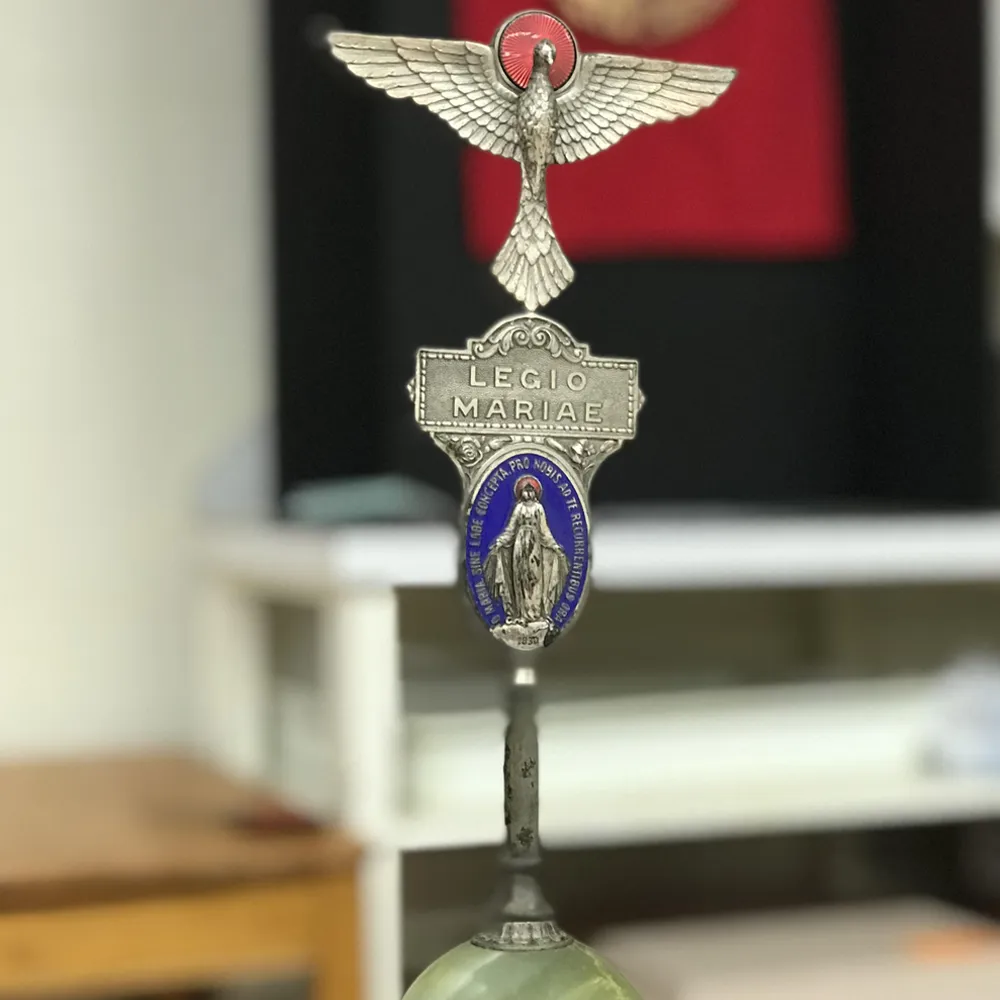
The Legion of Mary is the largest Catholic lay organization in the world. It numbers one and a half million active legionaries and about eleven million supporters. The basic organizational structure of the Legion of Mary is the praesidium. It consists of 14–15 lay members and a priest who serves as the group's spiritual director. He is appointed by the bishop. At all times, the Legion is at the disposal of that bishop.
Each praesidium meets weekly. At these meetings, the members of the praesidium recite prayers, report on the work accomplished, discuss the vital needs of their region as well as the issues of their own spiritual growth, and receive an apostolic assignment for the coming week.
The nature of the assignment varies according to the needs of each region. For example, a praesidium in Kenya conducts religious instruction classes for pagans. A praesidium in India runs reading and writing courses for the illiterate. Members of a praesidium in Chicago go daily to shelters for alcoholics and drug addicts, speak to them about God, and persuade these people with difficult destinies to turn to centers where they can receive help. Members of a praesidium in London visit former Catholics and take their children to Sunday Mass. Care for the sick, the elderly, and the destitute, as well as merciful visits to hospitals, prisons, etc., are part of the activities of many praesidia.
In various parts of the world, numerous praesidia are engaged in projects called "True Devotion to the Nation." The Legion of Mary constantly reminds its members that true religiosity necessarily implies a high degree of civic responsibility. In practice, this means that legionaries voluntarily offer real assistance to the state and their fellow citizens and call upon others to do the same. Examples of such assistance include guarding a farm while its owner is in the hospital; organizing savings banks among the less well-off; building housing for the homeless; digging wells or bringing water to the homes of the sick and elderly; and creating shelters for lepers.
Undoubtedly, such work could be done by paid staff, but the Legion regards the spread of voluntary assistance as an action vital to the realization of the ideals of true patriotism, and it ensures that this assistance is carried out solely out of charity.
"Whatever you did for one of the least of these brothers of Mine," said Christ, "you did for Me."
There is practically no type of activity in which the Legion does not participate, and successfully at that. The only thing the Legion does not undertake is direct monetary or material aid to people. The Legion's practical handbook explains the reasons for this policy.
The foregoing should not lead the reader to think that the primary aim of the Legion is the voluntary performance of a certain number of good works. Nor is the primary aim of the Legion to provide its supporters with a carefully devised system of methods for achieving success in their experience of building a righteous life. This work is undertaken by the Legion to ensure that the path of righteousness offered to legionaries, oriented toward apostolic, selfless service to others—similar to that which we observe in the practical activity of Christ in the Gospel—is faithfully followed. Indeed, the Legion is nothing other than the manifestation of the essential features of Christianity in practice. Pope John said of it: "The Legion of Mary represents the true face of the Catholic Church."
The defining characteristic of the Legion is its affirmation of the preeminent role of the Blessed Virgin Mary. She is truly the chief leader of the Legion. Legionaries seek ways to establish spiritual dependence on Her. They are reminded of God's plan concerning Her. In particular, they strive to imitate Her mercy, courage, Her humility, Her great faith.
The Legion of Mary was founded by a layman, Frank Duff, in Dublin, Ireland, on September 7, 1921. A few years later, its branches were established in Scotland and England. In 1937, it spread to India, and some time later arose in Africa, Australia, and China. And soon its branches were formed in every country. The creation of the Legion was a wonderful help to bishops and priests in their care for souls. Its simple structure and discipline made it acceptable to the educated and the illiterate, to developed and developing countries, to young and mature people.
Perhaps one of the most striking examples of the Legion of Mary's activity is how excellently it works in institutions for the elderly and disabled. The Legion does not merely help these people; legionaries do not simply visit them. Special praesidia have been established in these institutions; the elderly and disabled themselves become active members and supporters of the Legion. And it is not surprising that this new role gives them new strength and a new interest in life. It enables the realization of their potential aspirations and abilities to do good, despite their advanced age.
... THE LEGION OF MARY (conclusion)
Once I visited a praesidium in Dublin. It was in a hospital for the incurably ill. All the members of the praesidium, except for one person, had a serious degree of disability, and they all moved about in wheelchairs. It was wonderful to see how they carried out their activities in fulfilling the Legion's assignments—visiting other bedridden patients, reading books for the blind, writing letters for those who no longer had strength in their hands. And above all, it was wonderful to see the development among them of a beautiful spirit of Love, Humility, and Service. Furthermore, it was evident that through their work in the Legion, they had grown significantly stronger in prayer. And, of course, they had acquired greater resignation to their sufferings and their infirmity, because they understood that through their suffering bodies, the crucified Christ continues His redemptive mission.
Naturally, the greatest number of Legion praesidia are established for youth. Currently, there are many praesidia throughout the world for boys and girls under 18 years of age. However, they are youthful only in name and in the age of their members. In their high qualities, attitude to work, heroism, and true righteousness, they are perhaps in no way inferior to praesidia uniting adults. And indeed, some of these youth groups are so distinguished by righteousness and effectiveness of action that they could serve as a model for older legionaries.
One of the most famous names in the Legion of Mary is that of Edel Quinn. She was born in Cork, Ireland, in 1907. At the age of nineteen, she joined the Legion and attained a high degree of holiness. Despite very poor health, she voluntarily went to work as a Legion envoy in Africa. She spent the last seven years of her life there, dying in Nairobi in 1944. Her holiness was so great that documents supporting the possibility of her canonization were presented in Rome, and there is hope that she will be declared a saint of the Church.
In mission countries, and especially where there is a shortage of priests, the Legion of Mary has proven its particular value to the Church. Through the legionaries, the priest has been enabled to multiply his efforts and extend his pastoral influence not only within the bounds of his district, diocese, or parish. No soil was completely barren, no difficulty too great, no climate too harsh, no mountains too high to reach, no task absolutely impossible for these tireless apostles of the Legion of Mary.
The late Pope Paul VI sent a special message expressing praise and support to Frank Duff and the Legion of Mary. In this connection, Cardinal Cicognani wrote on behalf of the Pope: "Such a message from the Holy Father is fully merited by the piety, the many aims, and the multitude of good works which are wisely carried out and spread for the great benefit of the Catholic ministry, being a means of astonishing power in the establishment and spread of the Kingdom of God."
