


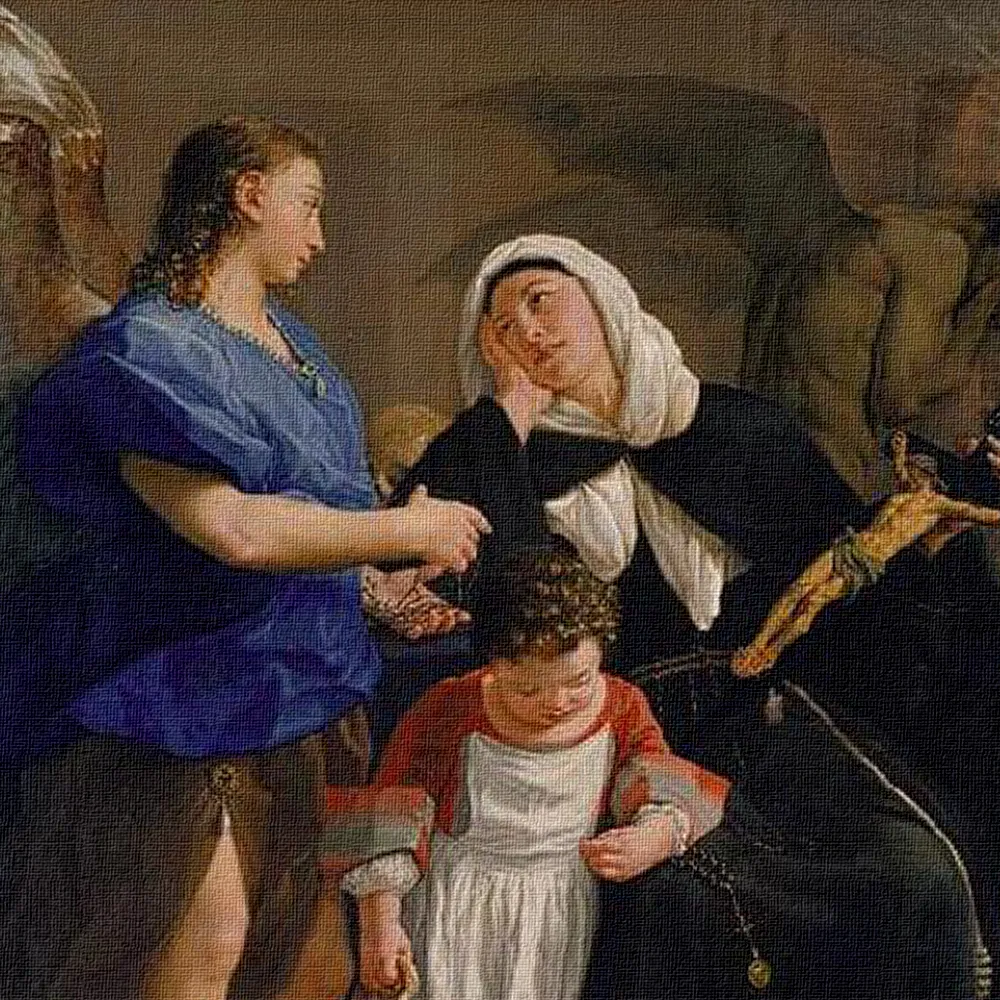
Saint Margaret of Cortona
In February, we honor the memory of a saint known to all lovers in the world — whoever they may be: Catholics, Orthodox, Christians, or Jews. Who does not know St. Valentine? Who among us has not sent their beloved a “valentine” — a card with doves and flowers (and a declaration of love), or given the object of their adoration chocolate? These and similar “follies” are performed on St. Valentine’s Day, February 14.
There were two Saints Valentine: one — a “simple” priest-martyr, and the second — a bishop from Terni. Which of them first began to mention lovers in his sermons and pray for them is unknown, but since the Middle Ages, lovers have devoutly honored “their” saint.
Often, together with Valentine, St. Margaret of Cortona is depicted. Her feast day is February 22, and she is the patroness of all penitent sinners — Margaret sinned much in her life and repented much.
The daughter of a peasant from Salerno, Margaret was born in 1247. She lost her mother early, and her stepmother did not particularly oversee her stepdaughter’s upbringing. Unsurprisingly, the 18-year-old peasant girl was seduced by a local nobleman. Margaret lived with her “protector” for nine years and bore him a son. Margaret’s beloved often went hunting, and one day only the dog returned home. Margaret followed it…
…and found a dismembered corpse in the forest. It is difficult to say how great Margaret’s remorse was — in any case, she soon returned to her former carefree life, and only when her lover’s money ran out did she try to reconcile with her father. Her stepmother drove the single mother and her son away.
But in Cortona, a noble lady noticed Margaret; she took her son into her care (he later entered a Franciscan monastery). Margaret herself also took vows as a nun.
Energetic and naturally shrewd, she soon managed to found a community of Franciscan Tertiaries and even build a hospital. The inhabitants of Cortona were amazed at the change that had occurred — Margaret gave herself entirely to her new life, just as she had formerly to love. And her repentance was so sincere that soon Cortona was flooded with crowds of pilgrims coming to “the sinner Margaret.”
In 1297, she passed away; her remains rest in a glass sarcophagus in the city of Cortona. Margaret is the patroness of penitent sinners.
Her entire life seems like an illustration of the Gospel words: “there is more joy in heaven over one sinner who repents than over ninety-nine righteous persons who need no repentance.” That is why we turn to St. Margaret on the eve of Lent — we who are in need of repentance.
